
An international importer, local-market distributor, or regional agent supplying residential and government solar projects in Peninsular Malaysia must confirm that Chinese grid-tied and hybrid photovoltaic (PV) inverters comply with the Energy Commission (Suruhanjaya Tenaga, ST) Net Energy Metering (NEM) technical framework before placing bulk factory orders. Under the ST Guidelines for Solar Photovoltaic Installation under the Programme of NEM Rakyat and NEM Gomen in Peninsular Malaysia (Rev. 1, 2026), grid-connected inverter hardware must satisfy strict anti-islanding, converter safety, bidirectional zero-export control, and after-sales component readiness requirements prior to distribution and utility interconnection.
1. Regulatory Mandate and Enforcement Timeline
Per the August 2026 Revision 1 issuance by Suruhanjaya Tenaga (ST), all grid-connected solar PV installations operating under the residential NEM Rakyat and government-building NEM Gomen tracks within Peninsular Malaysia fall under updated technical oversight built upon the Electricity Supply Act 1990 (Act 447) and the Electricity Regulations 1994. The regulatory boundary applies strictly to Peninsular Malaysia distribution networks managed by the utility distribution licensee, whereas Sabah and Sarawak administer separate regional grid interconnection regimes.
Before an engineering, procurement, and construction (EPC) contractor or regional agent can complete system commissioning and obtain bidirectional meter synchronization, the installed inverter model must demonstrate full conformity with Malaysian Standard (MS) and International Electrotechnical Commission (IEC) test reports accepted by local authorities. A local-market distributor importing non-compliant inverter batches risks customs clearance delays, utility rejection during NEM application review, and costly retrofit liabilities across residential and public-sector rooftops.
Scope of Covered Equipment and Program Tracks
- NEM Rakyat Installations: Domestic residential consumers in Peninsular Malaysia deploying single-phase or three-phase rooftop solar PV systems connected in parallel with the low-voltage distribution grid.
- NEM Gomen Installations: Government premises and public-sector facilities integrating medium-to-large commercial string or hybrid PV inverters with dedicated bidirectional metering and export-limitation controls.
- Covered Power Conversion Hardware: Grid-tied string inverters, hybrid solar-storage inverters operating in grid-parallel mode, and accompanying external energy meters, current transformers (CTs), and DC/AC isolation assemblies.
2. Technical Standards and Testing Specifications
Evaluating Chinese inverter factories requires verifying exact hardware firmware profiles and ILAC-MRA accredited laboratory test reports rather than accepting generic export datasheets. Under the ST NEM Rakyat and NEM Gomen (Rev. 1, 2026) framework, international importers must audit four primary technical pillars before finalizing purchase contracts.
Anti-Islanding Protection (MS IEC 62116)
Every grid-connected PV inverter must incorporate active and passive anti-islanding protection tested per MS IEC 62116 (or the equivalent IEC 62116 standard recognized by Malaysian authorities). Upon loss of utility grid voltage or frequency deviation beyond Peninsular Malaysia grid code thresholds, the inverter must cease energizing the distribution line within the mandated disconnection window. This prevents back-feeding hazard to utility line workers and protects neighborhood distribution transformers.
Power Converter Safety and Grid Harmonics (IEC 62109)
Inverter hardware architecture must conform to IEC 62109-1 (general safety requirements for power converters for use in photovoltaics) and IEC 62109-2 (particular requirements for inverters). Key hardware protections verified under these standards include residual current monitoring units (RCMU), array insulation resistance detection before startup, DC injection limitation into the AC distribution network, and thermal derating stability in high-ambient tropical enclosures. Where a local-market distributor pairs hybrid inverters with lithium iron phosphate (LFP) packs, reviewing the Hybrid Solar Inverters & High-Voltage LFP Battery Storage: Importer Grid-Code and BMS Compatibility Guide helps align inverter safety relays with battery management system (BMS) communication protocols.
Zero-Export Control and Bidirectional Metering Integration
NEM Rakyat and NEM Gomen installations require precise active power curtailment and export management at the point of common coupling (PCC). When site capacity or tariff rules restrict reverse power flow, the inverter must interface seamlessly with a certified bidirectional smart meter or split-core CT sensor via RS485 Modbus RTU or Ethernet. An international importer must confirm that the factory firmware includes a password-protected Peninsular Malaysia country code preset that locks maximum export power and ramp-rate limits against unauthorized user tampering.
Switchgear and Isolation Interface Requirements
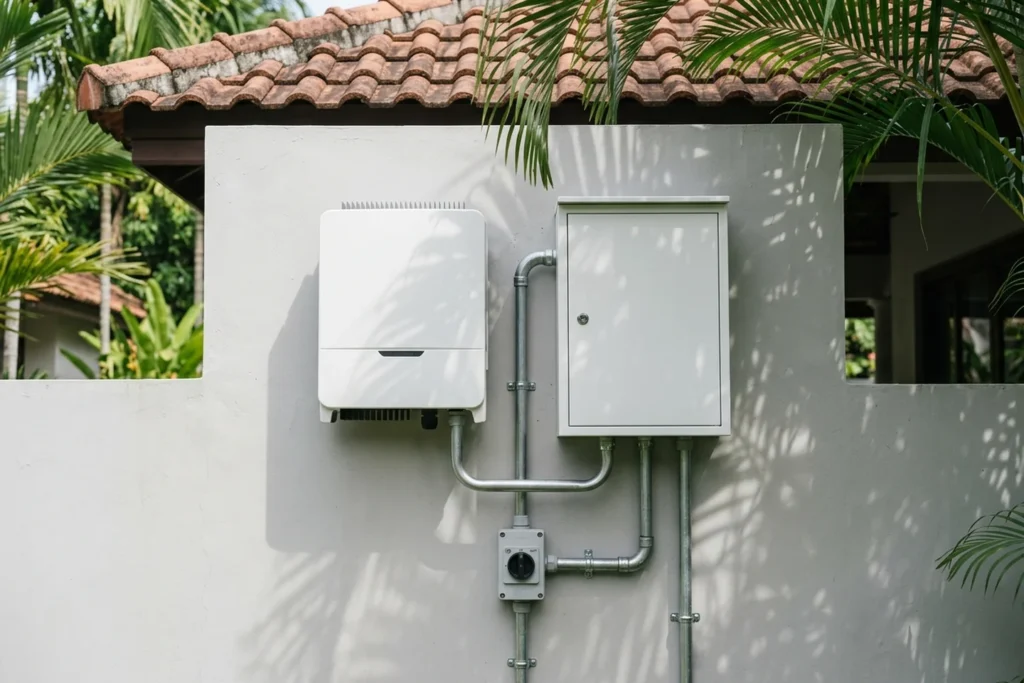
Field installations under the ST 2026 guidelines require visible, lockable DC rotary isolator switches alongside dedicated AC circuit-breaker enclosures and Type II (or Type I+II) surge protection devices (SPDs). While some Chinese string and hybrid inverters integrate built-in DC switches, regional agents must verify whether local ST-registered Competent Persons require external twin-pole rotary DC isolators and clearly labeled safety signage matched to the inverter’s maximum open-circuit input voltage (Voc) and short-circuit current (Isc).
3. Importer and Distributor Action Protocol
To prevent stranded inventory or rejected NEM interconnection filings, an international importer or local-market distributor should structure factory due diligence around a binding pre-shipment verification matrix and an enforceable spare-parts service protocol. Early regulatory scoping can also be structured using our companion guide on product certification planning before import.
| Compliance Dimension | ST NEM 2026 Technical Requirement | Required Factory Evidence | Importer & Distributor Verification Action |
|---|---|---|---|
| Anti-Islanding Protection | MS IEC 62116 / IEC 62116 active disconnection upon grid loss | Full CNAS / ILAC-MRA accredited type-test report matching exact model suffix | Cross-check PCB hardware version and firmware checksum listed on the test report against production samples |
| Converter Electrical Safety | IEC 62109-1 and IEC 62109-2 thermal, insulation, and RCMU safety | CB Scheme certificate and full IEC 62109-1/-2 test report package | Confirm internal RCMU trip thresholds and integrated DC switch ratings match factory bill of materials (BOM) |
| Zero-Export & Metering Control | Fail-safe active power curtailment via bidirectional meter or CT clamp | Factory zero-export response test log and RS485 protocol pinout manual | Bench-test CT loss-of-signal behavior to verify the inverter drops output to zero when communication is severed |
| Grid Parameter Firmware Lock | Peninsular Malaysia voltage (230V/400V) and 50Hz frequency trip settings | Signed factory parameter table for Malaysia ST grid profile | Verify password-protected installer menu locks grid code against end-user modification |
| RMA & Spare-Parts Readiness | Local swap units and board-level spares for tropical humidity and surge events | Contractual RMA annex specifying DOA buffer and PCB spare ratios | Establish local warehouse buffer stock before signing exclusive or non-exclusive distribution terms |
RMA and Local Spare-Parts Structuring
High ambient heat, coastal humidity, and frequent lightning transients in Peninsular Malaysia accelerate wear on cooling fans, DC/AC surge arresters, MPPT power boards, and communication daughterboards. Because residential NEM Rakyat customers and government NEM Gomen operators cannot tolerate multi-month sea-freight turnaround times for warranty repairs, a local-market distributor must negotiate upfront Return Merchandise Authorization (RMA) inventory before container loading. For a complete contract template on service-level clauses, review How to Audit Warranty, Spare-Parts and Service Readiness Before Distributing a Chinese Brand.
Pre-Shipment Compliance Checklist for Importers
- Exact Model Alphanumeric Match: Confirm that the model name on the commercial invoice, rating plate, and MS IEC 62116 / IEC 62109 test reports match character-for-character, including regional suffixes.
- Country Code Pre-Configuration: Require the Chinese manufacturer to pre-load the Malaysia 50Hz grid code and provide written release notes detailing over/under-voltage and over/under-frequency trip times.
- Meter & CT Bundling Verification: Order factory-calibrated smart meters and CTs in the same shipment lot as the inverters to prevent RS485 register mismatch on site.
- Pre-Funded Swap Pool: Secure at least 2% to 3% complete swap inverters and 5% critical wear parts (cooling fan trays, MPPT power modules, RS485 comms cards, and SPD cartridges) per container order.
- Serial Number Traceability: Obtain an electronic packing list mapping every inverter serial number to its factory hipot, burn-in, and firmware flash test record.
4. Certified Chinese Brands and Evaluation Matrix
Several established Chinese solar inverter manufacturers supply string and hybrid architectures engineered for Southeast Asian distribution grids. When evaluating potential suppliers through the ChinaBrandPath distributor sourcing hub, an international importer or regional agent should examine each brand’s Malaysian grid-code familiarity, local service footprint, and model-specific certification scope:
- Growatt residential and commercial string and hybrid solar inverters — Broad portfolio of single-phase and three-phase inverters widely deployed in rooftop PV programs, offering dedicated smart meter bundles for zero-export management.
- Deye low-voltage and high-voltage hybrid solar inverters — Flexible hybrid platforms supporting grid-tied zero-export CT sensors, diesel generator ports, and multi-mode backup configurations popular with regional installation teams.
- GoodWe grid-tied and energy storage PV inverters — Comprehensive residential and commercial C&I range featuring integrated arc-fault circuit interrupter (AFCI) options and modular communication dongles.
- Sungrow commercial and residential string PV inverters — Utility and rooftop inverter specialist providing high-ingress-protection enclosures and advanced grid-support firmware for public and commercial tenders.
- SOFAR solar grid-tied and hybrid storage inverters — Established exporter of string and hybrid units with dual-MPPT and multi-MPPT designs tailored for high-temperature rooftop environments.
Verification Boundary Notice: Inclusion of a manufacturer in this guide does not constitute an official endorsement or blanket certification across all product lines. Regulatory compliance under Suruhanjaya Tenaga (ST) NEM Rakyat and NEM Gomen (Rev. 1, 2026) guidelines is strictly model-specific and firmware-dependent. Every international importer, local-market distributor, and regional agent must independently inspect the unredacted MS IEC 62116 and IEC 62109 test reports, verify valid local registration requirements with Malaysian authorities, and execute a binding RMA spare-parts agreement prior to commercial importation.