
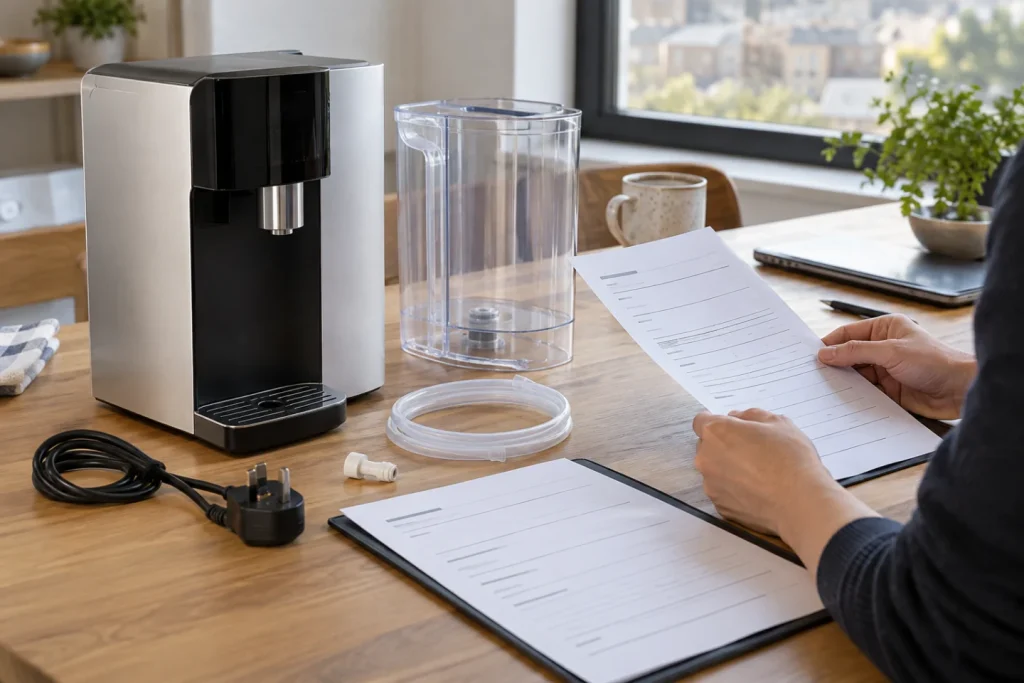
Before accepting a compliance-service quote, connect every proposed task to a specified appliance, destination, responsible party and deliverable. A price for “CE testing” is too vague to show which gaps will be closed or which importer obligations remain with your business.
This purchasing framework concerns household countertop drinking-water appliances sourced from China for England, Scotland and Wales. Northern Ireland and the EU require separate review. It does not determine that a particular appliance is compliant or that a quoted test programme is sufficient.
Freeze one appliance and one intended use
Record whether the unit stores, heats, cools or filters water; how it is filled; its rated supply; and whether it has a pump, wireless connection, replaceable cartridge or additional accessories. Capture the model and configuration, product claims, intended users, label, manual and the materials in the water path.
A countertop dispenser, a plumbed-in treatment system and a product making medical claims should not share a service scope merely because they all handle water. Ask the provider to identify exclusions and explain whether a changed feature requires another specialist or a separate assessment. Freeze this specification before comparing prices.
Separate the workstreams
| Workstream | Question for the provider | Defined output to request |
|---|---|---|
| Electrical safety | Does this exact configuration fall within the relevant equipment rules, and what assessment is proposed? | Applicability rationale, gap review and the assessment or testing scope linked to the model. |
| Electromagnetic compatibility | Which functions and operating conditions are included? Does a radio feature change the route? | Applicable framework and a documented evidence plan, including exclusions. |
| Restricted substances | Which existing material and component evidence will be reviewed, and what is missing? | Product-linked evidence assessment and any justified further work. |
| Water-contact materials | Which wetted parts, materials and use conditions are covered? | A material-specific assessment and clearly scoped supporting documents or tests. |
| WEEE and commercial roles | What producer or distributor obligations fall on our business, and which administrative tasks are included? | A responsibility map and explicitly included registration or scheme assistance. |
| Final file and artwork | Who prepares, checks and signs each document, and who owns the final labels and instructions? | A versioned handover list with unresolved conditions and responsible parties. |
The GB electrical-equipment guidance sets out importer checks. The EMC guidance addresses a different set of requirements. Have the provider state the actual route and its applicability instead of assuming one safety report answers both.
For equipment within scope, RoHS guidance also addresses technical documentation, declarations and marking. A laboratory logo or an unrelated component result is not a complete assessment of the finished appliance.
Make the water-contact boundary visible
Draw the water path from the inlet or reservoir to the outlet. List the tank, seals, tubing, valves, heater-contact surfaces and other wetted parts as applicable. Give the reviewer the actual materials, contact conditions, temperature range, intended repeated use and cleaning instructions. This is the input needed for a defensible scope discussion, not a universal test specification.
Ask whether a proposed report covers a raw material, a component or the finished assembly. Require an explanation of how it supports the intended appliance and use. A report for one plastic part should not silently become approval of every seal, coating or other material in the water path. Equally, do not order duplicate tests before a qualified reviewer has assessed usable existing evidence.
Food Standards Scotland’s guidance identifies the general food-contact framework and material-specific regimes. Ask the reviewer to identify the applicable GB requirements for the actual materials and use conditions. Do not use a generic “food grade” statement as the complete evidence package or assume an EU regulatory change automatically has the same GB implementation date.
Do not buy an undefined WEEE service
The UK WEEE guidance includes commercial importers among relevant producer roles and distinguishes producer from distributor obligations. These responsibilities are separate from an appliance test result. Ask what your provider actually supplies: role assessment, registration assistance, scheme liaison or only general advice.
Identify the entity that will place the equipment on the market and the planned sales route. Keep waste-equipment shipment advice separate from obligations associated with selling new equipment. Do not infer that hiring a consultant transfers statutory responsibilities to that consultant.
Compare quotes by closed gaps, not headings
Consider two hypothetical proposals. Proposal A includes testing an agreed sample but excludes review of existing reports, water-contact scope, labels and final-file handover. Proposal B includes a documented gap assessment before additional testing. The example does not establish that B is cheaper or better. It shows why the totals are not comparable until both proposals name their inputs and outputs.
For each line, record included models, sample quantity and condition, report ownership and access, deliverable format, exclusions, retest terms, design-change handling and completion dependencies. Ask whether fees cover a successful outcome or a defined piece of work that may reveal further gaps. Keep any estimate and its assumptions distinct from a fixed commitment.
Decide whether the scope is ready to accept
Accept the service scope only when the product and market are fixed, the provider’s competence fits the proposed tasks, deliverables answer the identified gaps, and every excluded obligation has an owner. Ask for a revised scope when an important area is unnamed. Pause when the proposal promises blanket approval without establishing the product or the relevant responsibilities.
Keep acceptance of the service quotation separate from approval to ship or sell the appliance. Use the certification-planning workflow for the wider evidence gates, and the exact-model document method where the selected conformity route makes it relevant. Reassess the scope whenever the design, materials, intended use or market changes.
