
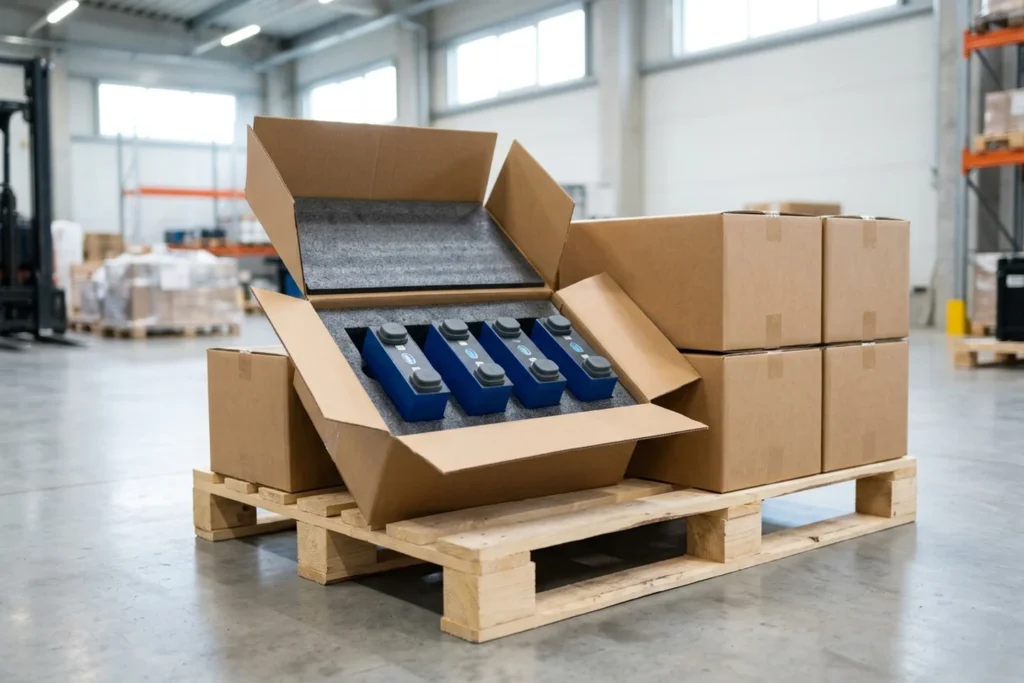
An international importer or local-market distributor shipping lithium-ion battery packs or battery-equipped power hardware from China by ocean freight must verify three documentary pillars before cargo gate-in: a model-matched UN 38.3 Test Summary, a current 16-section English Safety Data Sheet (SDS/MSDS) aligned with the cargo classification, and written Class 9 Dangerous Goods (DG) carrier booking acceptance with capped hazardous surcharges. Per the International Maritime Organization (IMO) International Maritime Dangerous Goods (IMDG) Code, lithium-ion batteries above exempted cell and watt-hour thresholds travel as Class 9 miscellaneous dangerous goods. When a regional agent releases final milestone payment or authorizes container drayage before reconciling the exact battery SKU, nominal watt-hour (Wh) rating, and UN number across the factory test summary and maritime Dangerous Goods Declaration (DGD), the shipment faces immediate terminal rejection, maritime line hazardous misdeclaration fines, or destination port quarantine.
UN 3480 Standalone Packs vs. UN 3481 Equipment-Packed Sea-Freight Rules
Ocean freight compliance begins with classifying the exact physical configuration of the shipment under the IMDG Code. Lithium-ion and lithium iron phosphate (LFP) energy-storage products fall into two primary Class 9 shipping entries, each carrying distinct packaging, documentation, and carrier stowage obligations for an international importer:
- UN 3480 (Lithium-ion batteries, standalone): Applies to standalone rack-mounted LFP modules, residential wall-mounted battery banks, stackable high-voltage storage bricks, and portable power stations shipped as self-contained energy storage units. Standalone battery shipments face the strictest vessel stowage controls, State of Charge (SoC) restrictions, and maritime terminal hazardous storage limits.
- UN 3481 (Lithium-ion batteries packed with or contained in equipment): Applies when battery cells or packs are factory-installed inside host hardware—such as commercial solar street lights, industrial cleaning machines, or portable medical and diagnostic tools—or packed in the same outer UN-specification carton alongside the host equipment required for operation.
A frequent operational failure occurs when a local-market distributor orders hybrid inverters together with rack-mounted LFP battery cabinets on a single commercial invoice and assumes the entire consignment qualifies as UN 3481. If the inverter and the battery cabinets are packed in separate pallets or cartons and the battery modules function as standalone energy storage bricks, maritime export terminals and vessel operators classify the battery pallets under UN 3480. Furthermore, if an international importer sources extra replacement battery packs alongside UN 3481 equipment in the same container, those spare modules must be declared separately under UN 3480 with their own UN-certified packaging certificate.
Under IMDG Code Packing Instruction P903 and Special Provision 188, packs exceeding 100 Wh (for lithium-ion batteries) or 20 Wh per cell are never eligible for small-battery exemptions. Residential and commercial energy-storage modules typically range from 2,560 Wh (2.56 kWh) to 15,360 Wh (15.36 kWh) per module, placing them squarely within fully regulated Class 9 ocean transport requiring UN performance-tested packaging (Packing Group II equivalent standards) and formal DG space allocation on the container vessel.
Observable UN 38.3, SDS, and Carrier DG Booking Evidence Before Gate-In
Before authorizing factory dispatch to a Chinese load port such as Shenzhen, Ningbo, Shanghai, or Qingdao, an international importer must inspect the physical and documentary evidence packet line by line. Vessel operators—and partner vessel-sharing alliance members that must counter-approve hazardous bookings—reject dossiers where model designations, watt-hour calculations, or company names diverge between lab reports and shipping declarations.
| Verification Dimension | UN 3480 Standalone Battery Modules | UN 3481 Batteries Contained In or Packed With Equipment | Observable Pre-Gate-In Evidence & Detention Triggers |
|---|---|---|---|
| UN 38.3 Test Summary Match | Mandatory per cell and assembled battery pack SKU; must state exact nominal voltage, Ah capacity, and Wh rating. | Mandatory for the internal or co-packed battery pack; host equipment SKU must cross-reference the tested pack code. | Detention trigger: Factory relabels a battery with the local-market distributor’s OEM brand code without updating the UN 38.3 Test Summary model list. |
| 16-Section English SDS / MSDS | Must specify UN 3480, Class 9, Packing Instruction P903, chemical composition, and current maritime code edition. | Must specify UN 3481, Class 9, exact mounting/co-packing configuration, and net battery weight vs. gross equipment weight. | Detention trigger: Expired SDS revision date or mismatch between the cell manufacturer’s SDS and the assembled cabinet’s outer marking. |
| UN Packaging Certificate (Wei-Bao-Zheng) | Mandatory Chinese customs inspection certificate for export dangerous goods packaging covering the specific carton or crate. | Required for UN 3481 packed with equipment; specific relaxation clauses apply only when rigid equipment housing provides equivalent protection. | Detention trigger: Supplier holds a valid UN 38.3 report for the battery cell but lacks export dangerous goods packaging certification for the palletized cabinet. |
| LCL vs. FCL Carrier Acceptance | High-watt-hour LFP cabinets are heavily restricted in LCL consolidation; most lines require dedicated FCL DG booking or specialized DG consolidators. | Broader LCL DG consolidation availability at major ports, provided total net explosive/lithium mass stays within consolidator container limits. | Detention trigger: Freight forwarder books high-capacity storage modules into standard dry LCL cargo without Class 9 manifest declaration. |
| State of Charge (SoC) & Labelling | Factory dispatch protocol must maintain SoC at or below 30% (where mandated by carrier rules and progressive IMDG amendments) with Class 9 lithium battery placards on all four container sides for FCL. | Equipment main circuit breakers must be locked against accidental activation during transit, with UN 3481 marks affixed to outer cartons. | Detention trigger: Missing four-sided Class 9 container placards or unverified SoC records during maritime safety administration spot inspections. |
Auditing the UN 38.3 Test Summary Under the UN Manual of Tests and Criteria
Since January 2020 under the UN Manual of Tests and Criteria (Revision 6, Amendment 1 and subsequent editions), battery manufacturers and distributors must make a standardized UN 38.3 Test Summary available down the supply chain. A valid Test Summary is not a one-page marketing certificate; it must list ten mandatory data elements, including the contact details of the cell or battery manufacturer, the unique identification of the test laboratory, the test report reference number and date, a physical description of the battery (chemistry, mass, watt-hour rating, and model number), the list of tests conducted (T.1 Altitude Simulation through T.8 Forced Discharge) with pass results, and a reference to the assembled battery testing requirements under 38.3.3(f) and 38.3.3(g) for large battery assemblies exceeding 6,200 Wh.
When a regional agent orders white-label or private-label LFP racks, the factory must either register the OEM model number as a recognized derivative on the laboratory’s Test Summary or maintain identical dual-model markings matching the tested master SKU. If customs inspectors or shipping line dangerous goods desks see Model A on the commercial invoice and packing list but Model B on the UN 38.3 Test Summary and SDS Section 1, the container is placed on immediate hold.
Step-by-Step Pre-Booking Hazardous Cargo Verification Protocol
To prevent unexpected port storage fees, vessel roll-overs, and unbudgeted freight add-ons, an international importer should execute a structured five-step verification workflow at least 14 to 21 days before the planned vessel ETD:
- Reconcile Model Codes and Watt-Hour Math Across Three Documents: Request the complete UN 38.3 Test Summary, the full 16-section English SDS, and the draft commercial packing list before paying the production balance. Multiply nominal voltage (V) by rated capacity (Ah) to confirm the exact Wh value matches across all three documents. Verify that the net weight of the lithium batteries is stated separately from the gross weight of the outer cabinet or pallet.
- Verify Export Dangerous Goods Packaging Certification: For shipments departing Chinese ports under UN 3480 or regulated UN 3481 categories, confirm that the factory holds the Performance Test Report and Usage Appraisal Result Sheet for Export Dangerous Goods Packaging issued by customs inspection authorities. Suppliers who quote low ex-works unit prices frequently omit the cost of UN-certified wooden crates or fiberboard cartons ($15 to $45 per package plus inspection batch fees), creating a multi-week bottleneck immediately prior to vessel cut-off.
- Secure Vessel Operator DG Approval Before Factory Dispatch: Dangerous goods bookings require review by the carrier’s hazardous cargo desk and, on shared loops, every partner vessel operator on the string. Approval typically takes 3 to 7 working days after submitting the SDS, UN 38.3 Test Summary, and draft Dangerous Goods Declaration. Never permit a trucker to pull a container or deliver cargo to a port warehouse before receiving the carrier’s written DG Booking Confirmation number. Because hazardous cargo terminals enforce strict free-storage windows (often only 24 to 48 hours before vessel berthing), early gate-in triggers steep daily hazardous yard storage charges.
- Lock In Hazardous Freight Surcharges and Reject Opaque All-In Quotes: Unscrupulous forwarders occasionally quote suspiciously cheap Less-than-Container-Load (LCL) or Delivered Duty Paid (DDP) rates by concealing Class 9 batteries inside general-cargo containers. If caught by maritime safety scanners or destination customs X-rays, the carrier imposes misdeclaration penalties ranging from $15,000 to $35,000 per container, along with indefinite cargo impoundment. Importers evaluating turnkey logistics offers should cross-check every surcharge line using the ChinaBrandPath guide on How to Audit a China DDP Quote Before Paying the Supplier.
- Confirm Factory Pre-Shipment SoC and Terminal Isolation: Require a timestamped factory QC log or Battery Management System (BMS) diagnostic printout confirming that standalone LFP or NCM packs are discharged to 25%–30% SoC prior to crating, high-voltage DC disconnects are locked in the OFF position, and exposed orange high-voltage terminals are capped with insulating protective covers.
Port Detention Risks and Energy-Storage Brand Partner Selection
The maturity of a Chinese manufacturer’s dangerous goods compliance infrastructure directly determines whether a local-market distributor can scale repeat container orders without supply chain interruptions. Tier-one energy-storage and inverter manufacturers maintain pre-validated UN 38.3 Test Summaries, standing export DG packaging allocations, and harmonized BMS-to-inverter safety certifications across their entire export catalog:
- Growatt residential and commercial energy storage systems provide standardized modular LFP battery architectures with pre-matched UN 3480 export documentation packets for regional distribution partners.
- Deye hybrid inverters and low-voltage or high-voltage LFP battery banks separate inverter cartons and standalone rack or wall-mounted battery modules under distinct customs and IMDG declarations to prevent mixed-pallet detention.
- SOFAR solar and integrated energy-storage hardware aligns international grid-code certifications with factory-issued UN 38.3 and Class 9 shipping dossiers for utility and C&I channel partners.
- BLUETTI portable power stations and home backup battery expansions ship under high-volume UN 3480 compliance workflows with serialized carton markings and multi-market safety approvals.
When a regional agent pairs inverters and high-voltage battery stacks from the same or cross-compatible ecosystems, maritime DG clearance must be coordinated alongside electrical grid and safety testing. Before finalizing technical specifications, review the companion guide on Hybrid Solar Inverters & High-Voltage LFP Battery Storage: Importer Grid-Code and BMS Compatibility Guide as well as Product certification planning before import to synchronize UL, IEC, CE, and UN 38.3 milestones before placing a deposit. Distributors building long-term regional agency portfolios can also evaluate vetted brand onboarding criteria through the ChinaBrandPath distributor and regional agent resource hub.
Closing Pre-Shipment DG Compliance Checklist
Before releasing final pre-shipment funds or authorizing container gate-in at the Chinese load port, an international importer should verify that every item below is signed off in writing:
- Exact SKU Alignment: The model code, nominal voltage, Ah capacity, and Wh rating on the commercial invoice and outer battery nameplate match Section 1 of the 16-section English SDS and the UN 38.3 Test Summary verbatim.
- Correct UN Classification: Standalone battery modules and portable power stations are declared under UN 3480, while batteries packed with or installed inside host equipment are declared under UN 3481, with zero undeclared spare packs hidden in general cargo cartons.
- Valid Export DG Packaging Certificate: The factory has supplied the official export dangerous goods packaging appraisal sheet covering the exact quantity and gross weight of the shipment lot.
- Confirmed Carrier Class 9 Space & Surcharge Cap: The freight forwarder has provided the shipping line’s written Class 9 DG booking confirmation, explicitly itemizing origin DG terminal handling charges, vessel hazardous surcharges, and destination DG port storage free-time limits.
- Physical Safety & SoC Readiness: Factory photos confirm UN number and Class 9 diamond labels on outer packages, four-sided container placards (for FCL), locked high-voltage disconnects, and documented State of Charge at or below 30%.