
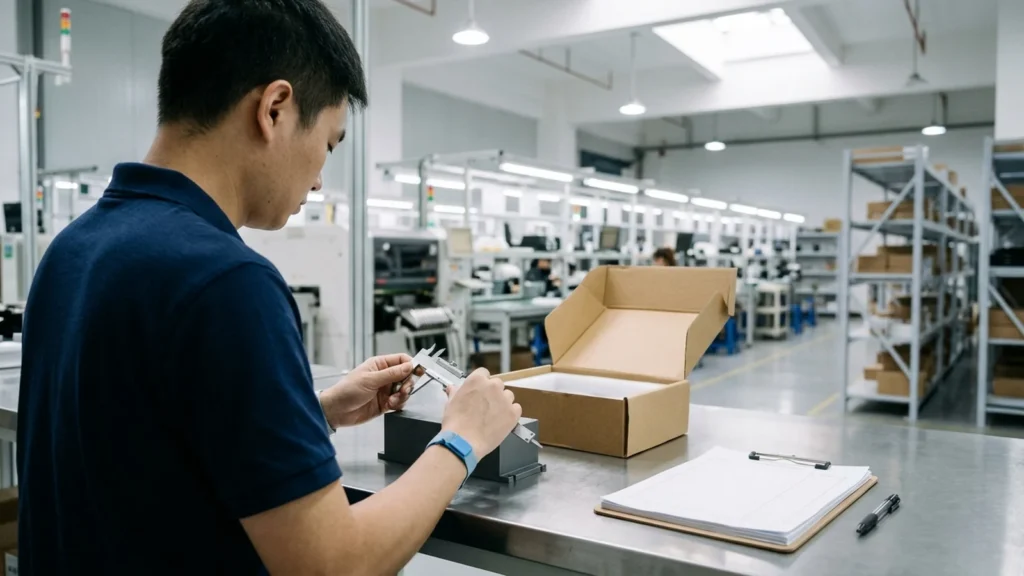
Direct answer: Across ChinaBrandPath’s November 2026 audit of 1,190 Chinese export brands (1,089 with mathematically verified 18-digit Mainland USCCs, or 91.5%), 81.0% (963 brands) operate in-house or subsidiary production facilities, while 19.0% (226 brands) are asset-light IP or design-led brand firms relying on contract OEM/ODM factories. That split shifts sharply by category, from 97.2% direct manufacturers in machinery and industrial equipment down to 61.9% in beauty and personal care and 68.0% in consumer electronics. Before signing a regional distribution deal or wiring a deposit, run the brand’s 18-digit code through the free China Supplier 18-Digit USCC License & Wire Verifier and match its registered manufacturing scope against the actual factory producing your trial batch.
Why Entity Structure Matters for Regional Distributors
Buying from an asset-light brand firm is not automatically a red flag; many leading Chinese consumer electronics, robotics, and cosmetics brands own strong industrial design, software, and trademarks while outsourcing assembly to Tier-1 contract manufacturers. The operational risk arises when an importer assumes a brand owns its production line and negotiates pricing, tooling ownership, warranty spares, or factory-floor quality control on that assumption.
- Direct manufacturers (81.0%) control production scheduling, raw-material sourcing, mold custody, and factory-gate ISO 2859-1 AQL pre-shipment inspections directly. They are typically better suited for custom packaging, private certification updates, and long-term spare-parts supply.
- Asset-light IP brand firms (19.0%) concentrate capital in R&D, brand marketing, and international channel management while contracting production to external EMS/ODM plants. Distributors must clarify who holds product-level CE, UL, NOM, or SASO certificates (the brand entity or the contract plant), which factory address appears on the export customs declaration, and how warranty replacements are funded.
- Offshore holding and unindexed entities (8.5%, 101 of 1,190 brands) operate international websites under Hong Kong, Cayman Islands, or BVI holding companies, or lack publicly indexed Mainland 18-digit USCC filings, requiring verification of the underlying Mainland operating or manufacturing subsidiary before wiring funds.
For the full four-party identity check covering legal entity, brand authorization, exporter of record, and bank beneficiary, pair this benchmark with our operational checklist on how importers verify a Chinese brand’s legal seller, exporter, and payment beneficiary.
2026 Benchmark Dataset: Overall Entity and USCC Findings
Every figure below comes directly from ChinaBrandPath’s verified directory snapshot (2026-11-27, n = 1,190 published Chinese export brands across 179 active distributor recruitment profiles). Each Mainland USCC passes the official GB 32100-2015 Mod-31 check digit algorithm and links to a public enterprise registry or regulatory filing. Offshore holding companies without a Mainland USCC are recorded as omitted rather than estimated.
| Audit Metric (Snapshot: 2026-11-27) | Verified Count | Share of Dataset | Importer Due-Diligence Takeaway |
|---|---|---|---|
| Total Published Chinese Export Brands Audited | 1,190 | 100.0% | Cross-sector export brands across 12+ primary categories |
| Mathematically Verified 18-Digit Mainland USCC | 1,089 | 91.5% | Passes GB 32100-2015 Mod-31 checksum plus public registry match |
| USCC Omitted (HK/Cayman/BVI Holding or Unindexed) | 101 | 8.5% | Verify the operating Mainland factory subsidiary before deposit |
| Direct Manufacturer (In-House or Subsidiary Plant) | 963 | 81.0% (of 1,189 classified) | Direct control over BOM, AQL QC access, and spare-parts continuity |
| Asset-Light IP / Design-Led Brand Firm (OEM/ODM) | 226 | 19.0% (of 1,189 classified) | Confirm certificate holder name and contract factory inspection rights |
| Active Verified Distributor Opportunities | 179 | 15.0% | 146 of 179 (81.6%) publish verified product compliance certifications |
| Median Brand Founding Year (n = 607 dated) | 2008 | 18-year median history | Established operating track record reduces fly-by-night exit risk |
Category Breakdown: Where Direct Factories Dominate vs. Where OEM Brand Firms Cluster
Importers evaluating Chinese brands should calibrate due diligence to the category’s real manufacturing structure. Heavy industrial, medical, and energy categories are overwhelmingly self-manufactured because tooling investment, ISO 13485/CE/UL factory audits, and batch traceability demand owned plants. In contrast, consumer electronics, smart home, and beauty feature high shares of design-led brand firms using Pearl River Delta and Yangtze River Delta contract manufacturing networks.
| Primary Industry Category (Top 12 by Brand Count) | Brands Audited | USCC Verified | Direct Manufacturer | IP / OEM Brand Firm | Direct Factory Share | Active Distributor Programmes |
|---|---|---|---|---|---|---|
| Machinery, Tools & Industrial Equipment | 72 | 63 | 70 | 2 | 97.2% | 27 |
| Health, Medical & Wellness | 68 | 64 | 65 | 3 | 95.6% | 9 |
| Energy, Electrical & Solar | 112 | 108 | 106 | 6 | 94.6% | 22 |
| Electronic Components & Industrial Automation | 83 | 80 | 75 | 8 | 90.4% | 20 |
| Building Materials, Lighting & Hardware | 48 | 42 | 42 | 6 | 87.5% | 7 |
| Agriculture, Garden & Farming | 64 | 58 | 55 | 9 | 85.9% | 13 |
| Automotive, Motorcycle & Mobility | 113 | 103 | 95 | 18 | 84.1% | 22 |
| Food & Beverage | 59 | 59 | 49 | 10 | 83.1% | 3 |
| Sports, Outdoor & Leisure | 58 | 52 | 45 | 13 | 77.6% | 10 |
| Home Appliances & Smart Living | 128 | 122 | 96 | 32 | 75.0% | 22 |
| Consumer Electronics & Digital | 291 | 271 | 198 | 93 | 68.0% | 25 |
| Beauty & Personal Care | 63 | 60 | 39 | 24 | 61.9% | 6 |
Note: Multi-category brands appear in each applicable primary sector; overall deduplicated totals remain 1,190 brands (963 direct manufacturers, 226 IP/brand firms, 1 pending entity classification).
Regional Concentration: What the 18-Digit USCC Province Code Reveals
Digits 3 through 8 of every valid Chinese USCC encode the statutory administrative division where the company registered. Across our 1,089 USCC-verified export brands, Guangdong, Zhejiang, and Jiangsu alone account for 68.3% (744 brands), led by Guangdong at 47.0% (512 brands), concentrated heavily in Shenzhen, Guangzhou, Foshan, and Dongguan. When a supplier claims to operate a factory in one coastal manufacturing hub while its USCC prefix points to an inland non-industrial district with zero branch plants, treat that mismatch as a prompt to verify whether the quoting entity is a sales subsidiary, a trading intermediary, or a brand-management office.
| Registration Province (USCC Digits 3-4) | Verified Export Brands | Share of USCC Pool (n = 1,089) | Typical Export Cluster Profile |
|---|---|---|---|
| Guangdong (Prefix 44) | 512 | 47.0% | Consumer electronics, power and solar, smart home, lighting, hardware (Shenzhen, Guangzhou, Foshan, Dongguan) |
| Zhejiang (Prefix 33) | 150 | 13.8% | Electrical components, appliances, tools, outdoor gear, light machinery (Hangzhou, Ningbo, Wenzhou, Taizhou) |
| Jiangsu (Prefix 32) | 82 | 7.5% | Industrial automation, solar cables, medical devices, precision machinery (Suzhou, Wuxi, Nanjing, Changzhou) |
| Shanghai (Prefix 31) | 71 | 6.5% | Brand HQs, beauty and skincare, medical and lab instruments, commercial equipment |
| Beijing (Prefix 11) | 54 | 5.0% | Robotics, AI hardware, industrial IoT brands (frequently paired with coastal plants) |
| Shandong (Prefix 37) | 43 | 3.9% | Agricultural machinery, commercial kitchenware, appliances, tires and automotive |
| Fujian (Prefix 35) | 37 | 3.4% | Electronic components, power tools, outdoor equipment, sanitary ware (Xiamen, Quanzhou, Fuzhou) |
| Anhui / Hunan / Sichuan / Henan / Hebei (Combined Top 8-12) | 80 | 7.3% | Automotive and EV, heavy machinery, specialized industrial equipment, food processing |
Four-Step Verification Workflow Before Your First Trial Order
- Validate the 18-digit USCC and region code offline: Paste the supplier’s code into the China Supplier 18-Digit USCC License & Wire Anti-Fraud Verifier to confirm GB 32100-2015 check-digit validity, decode the statutory city and district, and check Pinyin alignment against the English bank beneficiary name on your proforma invoice.
- Read the registered business scope (jingying fanwei) for production rights: Direct manufacturers hold explicit production, manufacturing, or processing clauses on their own license or on a verifiable wholly owned or majority-owned manufacturing subsidiary. Licenses reading strictly R&D, sales, technical development, and import/export (excluding manufacturing) indicate an asset-light brand or trading entity.
- Bind quality control and certifications to the real shipping factory: When working with an IP/OEM brand firm, require the brand to disclose the contract factory address prior to balance payment so pre-shipment ISO 2859-1 AQL inspection takes place at the actual production line and product certificates (CE, UL, NOM, SASO, SNI) match the exact SKU model.
- De-risk entry with verified recruitment routes and consolidated trial orders: Explore verified Chinese brand distributor opportunities where entity classification, USCC status, and cooperation parameters are pre-audited, or submit a free ChinaBrandPath distributor assessment to coordinate multi-brand sample consolidation, pre-shipment QC, export customs, and DDP/CIF/FOB delivery through our China ground team.
Risks, Exceptions, and Methodology Boundaries
- Public registry snapshots evolve: Companies relocate, rename, or add manufacturing subsidiaries over time. A historical USCC prefix (such as Shenzhen 4403) can legally remain unchanged after a firm relocates its plant to another province.
- Holding-company structures are normal for listed groups: Major Hong Kong- or US-listed Chinese brand groups often place a Cayman or Hong Kong holding company on global investor pages while operating multiple licensed Mainland plants underneath. Omitting a Mainland USCC on the holding entity does not imply illegitimacy; importers simply verify the contracting Mainland operating subsidiary.
- Directory verification does not grant exclusivity: ChinaBrandPath’s entity audit confirms corporate identity and manufacturing model, not exclusive regional distribution rights or inventory availability, which always require written brand confirmation prior to payment.
Pre-Order Entity Verification Checklist
- 18-digit USCC passes GB 32100-2015 Mod-31 check and matches the legal entity on the proforma invoice.
- Registered business scope confirms either direct manufacturing or an identified contract OEM factory for pre-shipment AQL inspection.
- Bank wire beneficiary matches the verified legal entity with no unverified third-party Hong Kong switch.
- Destination compliance certificates (CE, FCC, UL, NOM, SABER, SNI) list the exact SKU model and accountable manufacturer or brand entity.
- First order starts with consolidated paid samples or a bounded trial batch tied to pre-shipment QC sign-off.