

A business licence, trademark result, export filing and bank letter can each be genuine while still referring to different companies. The importer’s decision is therefore not whether four documents exist. It is whether the legal seller, brand rights holder or authorized seller, exporter and payment beneficiary form one documented and independently checked chain for the exact transaction.
Video guide · English
5:41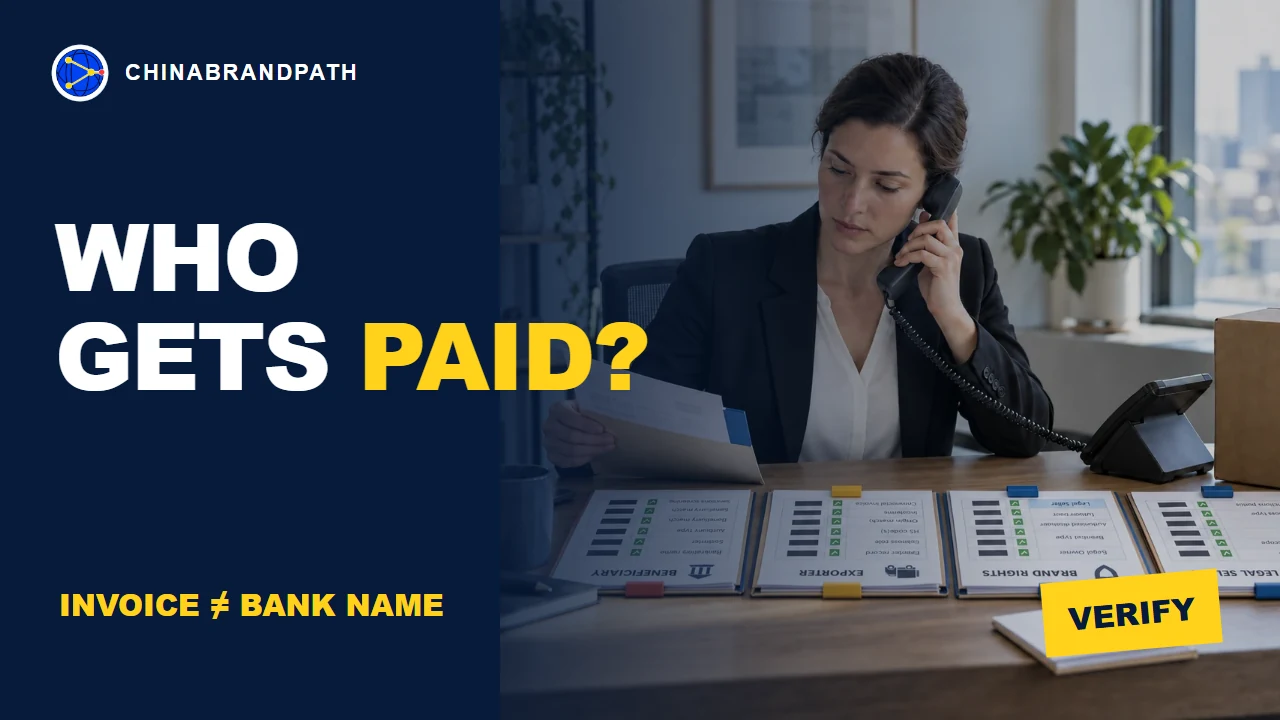
Direct answer: record the Chinese legal name and Unified Social Credit Code of every company, verify each identity through an official or independently obtained source, require written evidence for every relationship, and authenticate payment instructions outside the email thread that supplied them. A difference between parties is not automatically fraud, but an unexplained or unauthenticated difference is a stop condition before payment.
This Guide addresses one decision: whether the four-party identity chain for a Chinese-brand order is sufficiently documented and verified for the importer to advance to payment and contract review. It is a commercial due-diligence framework, not legal, banking, customs, sanctions or trademark advice. The required documents and legal effect depend on the companies, product, payment route and destination.
Four identities, one transaction
Begin with the purchase order, quotation or pro forma invoice and create one identity sheet. Do not rely on an English trading name alone. For each Chinese entity, request the full registered Chinese name, Unified Social Credit Code, registered address and legal representative or responsible contact. For a non-Chinese entity, record the equivalent registry identifiers and jurisdiction.
| Identity | Evidence from the counterparty | Independent check | Condition to advance |
|---|---|---|---|
| Legal seller | Business licence, signed quotation or contract, tax and contact details | Search the exact Chinese name or Unified Social Credit Code in the official enterprise system | The active entity and contract identity match, and the signatory’s authority is documented |
| Brand rights holder or authorized seller | Trademark details and, when needed, a dated authorization or licence chain | Check current national or regional trademark records and the relevant owner | The mark, goods or services, territory, products and authorization scope cover the proposed sale |
| Exporter or customs declarant | Exporter identity, role description and agency or trading agreement where another entity exports | Check the official enterprise-publicity route and obtain transaction-specific export evidence at the agreed milestone | The exporter’s role, document flow and responsibility are written into the transaction |
| Payment beneficiary | Bank-account confirmation bearing the beneficiary’s legal name and a contractual explanation for any third party | Authenticate through a known official contact and the importer’s bank controls | The beneficiary and payment route are approved, consistent with the contract and independently re-confirmed |
The table is a control record, not a document shopping list. Save the source URL, query, date, downloaded record or screenshot, person who checked it, discrepancy and next action. Use original-language names throughout so that similar English translations do not merge different entities.
1. Verify the legal seller
Search the company through China’s National Enterprise Credit Information Publicity System using its exact name or Unified Social Credit Code. The system’s official help explains that searches can use those identifiers and that published information comes from government departments and market entities. Compare the result with the licence and contract rather than accepting a cropped image.
Record the entity status, registered name, code, address, legal representative and business scope shown at the time of review. Treat the business scope as context, not a guarantee of capability or permission for the exact transaction. A registry match shows that the entity record exists; it does not prove product quality, brand authority, solvency or performance.
Confirm who signs for the seller. If a salesperson or another company signs, obtain the power, seal or other evidence appropriate to the agreement and have qualified counsel assess it when the exposure warrants that work. The official-domain email, website and telephone should be independently obtained and recorded, not copied only from the payment email.
2. Verify the right to sell the brand
Search the relevant trademark owner through the China National Intellectual Property Administration trademark-search route and, for a broader screening view, the WIPO Global Brand Database. WIPO notes that its database may not contain the most recent national data and recommends also checking national or regional registers. Search the mark itself, the owner’s exact legal name, status, classes and designated territories.
If the seller is not the recorded owner, require a traceable authorization or licence chain. It should identify the rights holder and seller, brand or mark, covered products, territory, channels, start and end dates, sublicensing rights where relevant, and the person signing for each entity. Authenticate the document with the rights holder through an independently obtained route.
A trademark result does not prove that every branded unit is genuine or that the seller may appoint a distributor. Conversely, a legitimate manufacturer may produce under licence without owning the mark. The decision depends on the documented relationship and the exact scope, not on identical company names.
3. Verify the exporter and declarant relationship
Ask which entity will appear as exporter, consignor or customs declarant and why. China Customs publishes an enterprise-information publicity and filing route, including the filing service for import and export consignees and consignors. Use the relevant official result as one identity check, then require transaction evidence that links the exporter to the seller and goods.
A seller and exporter can differ for a legitimate commercial reason, such as an agency-export arrangement. Current guidance from China’s State Administration of Foreign Exchange describes the principle that the party exporting receives the foreign exchange and notes that an agent can receive funds in agency-export business when the agency relationship is documented. SAFE also describes limited situations in which the import or export party may differ from the customs declarant when authenticity and commercial rationality are supported.
Do not turn those possibilities into a blanket exception. Obtain the agency, trading or service agreement that connects the parties; identify who issues the commercial invoice, packs and ships the goods, supplies customs data, receives proceeds, handles export tax matters and answers for errors. At the agreed release point, compare the commercial documents with the actual transport and customs records.
4. Authenticate the payment beneficiary
Place the beneficiary’s legal name, bank name, account jurisdiction, currency and payment purpose in the signed contract or an approved schedule. Compare them with the quotation, invoice and identity sheet. If a related company, export agent, collection provider or other third party will receive funds, require a written explanation and agreement that identifies the relationship, debt-discharge effect, refund route and responsibility for misapplied funds.
Verify payment instructions through a trusted channel obtained independently of the message requesting payment. The FBI’s business-email-compromise guidance advises independently verifying payment or account changes and looking up the company’s telephone number rather than using details supplied in the request. Apply that control to the first payment as well as later changes.
Use dual approval inside the importer’s organization, preserve the verification record, and ask the importer’s bank what beneficiary-name and fraud controls are available. Urgency, secrecy, a newly substituted account, a personal account, an unrelated jurisdiction or resistance to verification should stop payment until resolved. A familiar email thread or correctly copied invoice does not authenticate the bank account.
Explainable differences and stop conditions
A mismatch is explainable only when its commercial reason, legal relationship and transaction effect are documented and independently authenticated. Examples may include a brand owner licensing a seller, a manufacturer selling through a trading company, or an export agent handling customs and receipts. The importer still needs to know which entity owes delivery, warranty, refund and indemnity obligations.
Stop before payment when the registered name or code cannot be matched; the seller refuses to identify the rights holder, exporter or beneficiary; an authorization cannot be confirmed with the issuer; signatures, seals or dates conflict; the account belongs to an unexplained party; payment instructions change without out-of-band confirmation; or the proposed documents leave no entity clearly responsible for delivery and refund.
Clarify and re-check when the relationship is commercially plausible but the agreement is incomplete. Do not solve the gap by accepting a seller’s verbal explanation. Add the missing schedule, authorization, agency evidence or bank confirmation, then repeat the independent checks.
Use a payment-release sequence
- Freeze: exact product, seller, rights holder or authorized seller, exporter, beneficiary, amount, currency and destination.
- Collect: full documents and relationship evidence from the counterparty.
- Check: official registry, trademark and customs-publicity sources using exact legal identifiers.
- Authenticate: confirm authorization and bank instructions through independently obtained contacts.
- Resolve: write down every mismatch, commercial reason, evidence, owner and deadline.
- Contract: name delivery, document, warranty, refund and dispute responsibilities for every involved entity.
- Approve: use two-person payment control and a recorded decision of advance, clarify, restructure or stop.
- Reopen: repeat the check when the seller, exporter, beneficiary, amount, account or transaction structure changes.
Continue broader commercial review with the distributor commercial terms checklist. Before accepting model-specific compliance documents, use the exact-product CE document check where EU rules apply. If an all-in import route is proposed, use the China DDP quote audit to test the importer, declarant and customs-document chain.
One-page verification record
- Exact order, product models, amount, currency, destination and intended payment date.
- Chinese legal name, Unified Social Credit Code and registered details for each Chinese entity.
- Legal seller, signatory authority and contract responsibility.
- Trademark owner, authorization chain, products, territory, channels and validity.
- Exporter or declarant, filing evidence, agency relationship and document responsibilities.
- Beneficiary, bank, account jurisdiction, contractual payment basis and independent confirmation.
- Every mismatch, explanation, evidence source, checker, check date and remaining condition.
- Owners for delivery, warranty, refund, customs errors and dispute escalation.
- Decision: advance, clarify, restructure or stop; approvers and next review trigger.
Sources and limits
The official screening routes used here are China’s National Enterprise Credit Information Publicity System, the CNIPA trademark-search service, the WIPO Global Brand Database guidance, and the China Customs online-service catalogue. The exporter-and-receipt discussion is bounded by current SAFE guidance on trade foreign-exchange receipts and SAFE guidance on the trade foreign-exchange enterprise directory. These sources help verify records and structure questions; they do not certify a counterparty or replace transaction-specific professional advice.
Reader language was informed by a public Reddit discussion from a buyer preparing a first bulk order whose sample had passed but whose supplier proposed a Hong Kong beneficiary and a nominated export company, and who asked whether a licence, authorization and bank proof were enough. A separate public discussion contrasted verifying that a company exists with deciding whether it is safe for a specific order. These are self-selected anecdotes that identify the decision problem, not its prevalence, and they do not establish facts about a supplier, platform, brand or market. The framework above relies on official sources and independently verified transaction evidence.
For the broader first-screen decision, use the Chinese-brand distribution evaluation scorecard. For material exposure, have qualified legal, banking, customs, tax, sanctions and trademark specialists review the structure in the relevant jurisdictions.
