
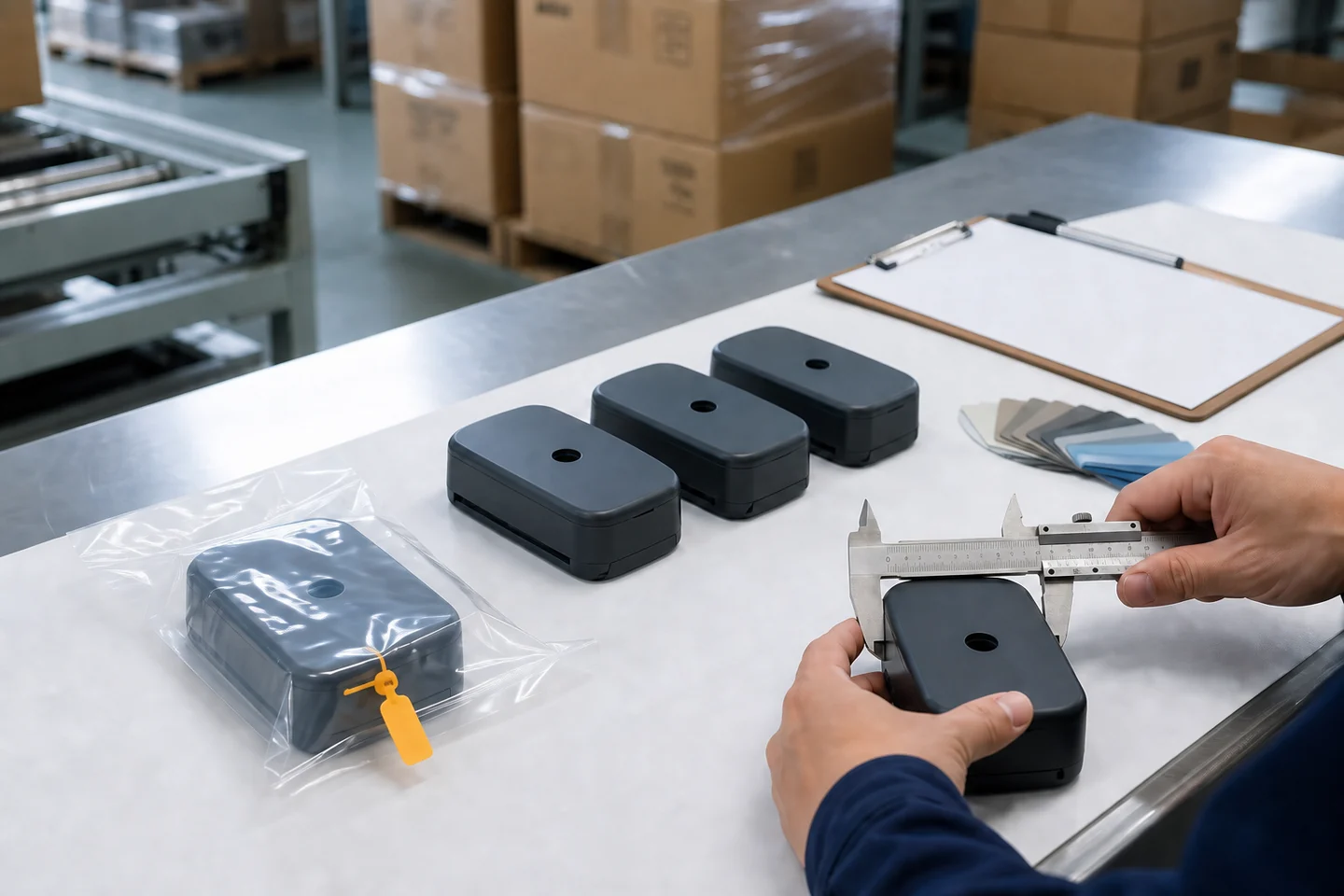
An approved sample does not control mass production by itself. It becomes useful only when the buyer and supplier turn it into an identified physical reference, pair it with written specifications and use both in an agreed inspection and payment-release process.
Direct answer: do not release the balance because a supplier says production is complete. Release it when the identified production lot has been checked against the controlled sample and specification, the agreed acceptance rules have been applied, and every material exception has a documented disposition.
This Guide addresses one decision: whether the bulk production lot demonstrably matches the approved sample and frozen specifications before the importer pays the balance. It is a quality and commercial-control framework, not legal, engineering or product-compliance advice.
Why a good sample can still lead to a bad bulk order
A development sample may be made slowly, selected from several attempts or built with components that are easy to obtain in a small quantity. Mass production introduces line speed, multiple operators, material lots, tooling, subcontractors, packaging versions and process variation. A mismatch can also arise from ambiguous instructions rather than deliberate substitution.
The practical problem is evidence. If the buyer approved only appearance in a chat message, the supplier may not know which dimensions, materials, colours, functions, accessories, labels or tolerances are controlling. The inspector then has no objective basis for deciding whether a difference is acceptable.
Importer discussions frequently describe this exact gap: the sample feels right, while the bulk lot uses a thinner material, a different texture or a defect the supplier considers minor but the buyer considers unsellable. The remedy is not more trust language. It is a shared release standard.
1. Name the sample that actually controls production
Do not use “golden sample”, “approved sample” and “pre-production sample” as interchangeable labels unless the purchase file defines them. Give the controlling unit a unique reference such as GS-01, revision B, approved 14 August 2026. Record the product model, supplier, factory, purchase order and approvers.
Use tamper-evident packaging or signatures across the seal. Ideally, the buyer and factory each retain a matching approved unit, and the inspector can access an authenticated reference. Photograph all sides, critical details, label, accessories and packaging before sealing. A retained unit is a comparison aid; it does not replace measurements, tests or a written specification.
2. Freeze a written specification beside the sample
A physical sample cannot reveal everything. It may not show material grade, internal components, firmware, performance limits, coating thickness, test method or an acceptable tolerance range. Build one controlled specification pack and reference its version in the purchase order.
| Control item | Minimum evidence to freeze | Typical inspection use |
|---|---|---|
| Identity | Model, revision, colour, factory, purchase order and sample ID | Confirm the inspected lot is the lot ordered |
| Materials and components | Material grade, critical component list, approved supplier or equivalent rule | Document review, measurement or agreed verification test |
| Dimensions and performance | Nominal values, tolerances, units, test conditions and equipment | Measure a defined sample and record actual results |
| Appearance and workmanship | Colour reference, finish, approved photos and defect examples | Compare under agreed lighting and viewing conditions |
| Software and configuration | Firmware, region settings, app or account requirements and approved functions | Power-on or functional checks using a named procedure |
| Pack-out | Accessories, labels, manuals, packaging artwork, carton marks and quantities | Open random cartons and reconcile contents and versions |
Classify defects by their commercial or safety consequence and attach clear examples. Avoid copying generic “critical, major and minor” labels without defining what each means for this product. The buyer, supplier and inspector should be able to reach the same classification from the same evidence.
3. Put every requested correction into revision control
Sample approval often fails because the buyer asks for five corrections across email, messaging apps and annotated photos, then approves “the sample” without confirming which changes were incorporated. Use a revision table with one row per requirement: requested value, supplier response, evidence, owner, approval date and resulting specification version.
Once production is released, require written approval before a controlled material, component, process, factory, artwork, firmware or packaging change. State whether a change requires a new sample, additional testing, a price decision or a revised delivery date. Silence must not count as approval.
For regulated products, a commercial sample approval is never a substitute for conformity review. The EU common framework for product legislation says manufacturers should maintain series-production conformity and take product-design, characteristic and technical-specification changes into account. Use the separate product certification planning Guide to connect the production reference to model-specific evidence.
4. Design the inspection before production starts
Choose the control points from the product risk, order value, process maturity and cost of discovering a defect late. A useful plan may combine:
- Pre-production verification: confirm materials, components, artwork, tooling, reference sample and test instructions before the line starts.
- During-production inspection: detect a process or component problem while rework may still be practical.
- Pre-shipment inspection: check a randomly selected sample from the identified finished lot before shipment and balance release.
- Container-loading or dispatch checks: verify quantities, carton identity, loading condition and seal evidence where substitution or handling risk is material.
If acceptance sampling is used, name the standard, edition, lot size, inspection level, defect classes, AQL values and switching or rejection rules. ISO 2859-1:2026 defines AQL-indexed sampling schemes for lot-by-lot inspection by attributes. An AQL plan does not promise a defect-free shipment and does not decide which product requirements matter; those choices must be defined in the buyer’s quality plan.
5. Give the inspector a release-ready brief
The inspection brief should reach the inspector before the visit, not while the inspector is standing at the factory. Supply the purchase order, lot and carton data, controlling sample ID, specification revision, approved artwork, defect definitions, test methods, sampling plan and required photographs.
Require the report to identify the factory, date, production lot, available and packed quantities, carton-selection method, sample size, instruments, results, defects, photographs and any test that could not be completed. A pass/fail cover page without underlying observations is too weak for a payment decision.
Keep the inspection independent from the factory’s choice of “good” units. If an on-site independent inspection is disproportionate for a small pilot, preserve random selection in another documented way and record the limitation. A supplier-led video call can add visibility, but it is not equivalent to independent sampling or a competent technical inspection.
6. Separate inspection result from the payment decision
The inspector records evidence against instructions. The importer decides what that evidence means commercially. Use four dispositions:
- Release: the agreed acceptance rules were met, required documents are complete and no unresolved exception blocks shipment.
- Conditional release: only explicitly accepted deviations remain, with a written concession describing affected quantity, price or warranty treatment and who approved it.
- Correct and reinspect: the supplier completes a defined rework or replacement plan, segregates affected stock and a new inspection verifies the correction.
- Pause or reject: identity, safety, function, controlled component, compliance evidence or other agreed release requirement is materially unresolved.
Do not ask an inspector to negotiate a discount or authorize payment unless that authority is expressly assigned. Do not turn a failed result into a pass by accepting undated factory photographs after the visit. Rework evidence should be traceable to the affected lot and verified at a level proportionate to the risk.
7. Link the balance to evidence in the commercial terms
The purchase order or agreement should state the event that makes the balance due: production completion alone, a passed agreed inspection, delivery of specified documents, or another defined milestone. It should also cover inspection access, notice period, rework, reinspection cost, delay, rejected goods and the effect of an approved deviation.
These terms require legal and commercial review for the transaction. An inspection does not by itself create a refund right or guarantee recovery after a dispute. Align the quality gate with the payment schedule in the distributor commercial terms checklist. If the supplier also controls a DDP route, audit the customs and final-delivery evidence before relying on the quoted landed cost. Verify the seller and payment beneficiary separately before transferring funds.
A proportionate plan for a small first order
Small importers often face a real trade-off: a full third-party inspection can feel expensive relative to a 50- or 100-unit pilot, yet one unusable batch can absorb the entire learning budget. Do not solve that problem by pretending the risk is zero. Scale the control plan, and use the controlled first-order sizing method to cap cash, SKU breadth, inventory age and warranty exposure before the quality plan is priced.
- Keep the first order small enough that failure is survivable.
- Freeze the same sample and specification pack even when the batch is small.
- Prioritize identity, safety, key function, costly defects and pack-out instead of testing every low-risk cosmetic attribute.
- Ask whether the inspector can combine checks, use a shorter risk-based scope or work through a trusted local representative.
- Retain random units from the pilot for comparison with the next reorder.
- Increase inspection depth when volume, customization, defect history or customer consequence increases.
The goal of a pilot is evidence, not merely a low unit count. Use the sample and production consistency decision hub to record the gate, then carry the accepted quantity and payment conditions into the landed cost, payment and delivery stage.
One-page balance-release record
- Supplier, factory, purchase order, exact SKU and production-lot identity.
- Golden-sample ID and location of buyer, factory and inspector references.
- Specification, artwork, firmware and packaging revision numbers.
- Approved changes since sample sign-off, with evidence and approver.
- Inspection provider, date, sampling plan, tests and report link.
- Defects and deviations by classification and affected quantity.
- Corrective action, reinspection or written concession where applicable.
- Required compliance and shipping documents received and checked.
- Final disposition: release, conditional release, correct and reinspect, or pause/reject.
- Name, date and authority of the person approving payment and shipment.
If any controlling reference is missing, the answer is not automatically “reject”. It is “the lot has not yet demonstrated conformity to an agreed release standard”. Close that evidence gap before using the balance payment as the point of no return.
Sources and limits
This workflow uses ISO 2859-1:2026 as the official starting point for AQL-indexed lot-by-lot attribute sampling and Decision No 768/2008/EC for the EU principle that series production should remain in conformity and product changes should be taken into account. Product rules, contracts, inspection methods and remedies vary by category and jurisdiction; use qualified specialists where the consequence requires them.
